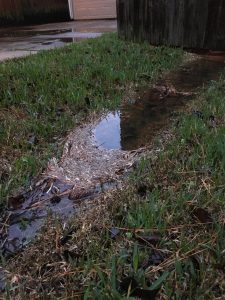
Fire ants are not fish. They do not like to be submerged in water. Therefore higher parts of your garden are most at risk for fire ants. This is often why mounds are observed at the base of trees and sadly, raised beds. Rainy weather can be tricky for working in the garden. Often times when it is raining the motivation to go outside is low. However, if I have a little energy to get out of doors I always enjoy gardening in the rain. It is a chance to see how drainage is working in your garden and also it is a great time to plant and transplant as the high humidity and moist ground are good for seeds and transplants.
In fire ant country rain has a mixed effect on the ants. If the ant pile is not submerged then activity will be subdued as the ants are not as active foraging in wet conditions. However, if the ant mound has been inundated with water then the ants are going to be on the move and this is what you want to watch out for. One of the most fascinating things about the habits of Solonopsis invicta is the ability for the colony of ants to climb over each other and cling to each other forming a writhing ball of ants that can float. A floating ball of thousands of stressed out fire ants is not something you want to approach. In the home garden this is unlikely to be encountered, however the formative stages of a floating fire ant ball may start to form on floating debris in your yard. So, if there is standing water in your yard and there is a leaf or stick floating on it, keep your eyes out for stowaway ants. When the floating debris piles up as the water drains this is a prime location for this ants to accumulate. This debris is also a prime candidate for an active gardener to grab with her hands. Ouch! So, stay alert and wait to pick up accumulated wet debris until it has dried out, or use a long handled tool. That is the fire ant tip of the day.